

Description
- Description
- Specs
- Labels and SDS Forms
Prodoxaben G Granular Herbicide
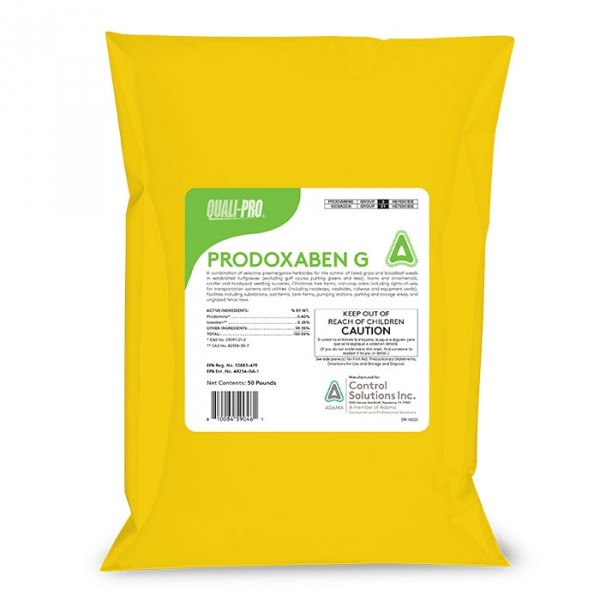
Prodoxaben G is a professional selective preemergence herbicide combining 0.40% prodiamine and 0.25% isoxaben for broad-spectrum prevention of grassy and broadleaf weeds in established turf, lawns, sod farms, ornamentals, nurseries, Christmas tree farms, and labeled non-crop areas. Its dual HRAC Group 3 + Group 21 chemistry provides two modes of action for extended residual weed control and resistance-management programs.
Designed for convenient granular broadcast application, Prodoxaben G controls or suppresses more than 150 labeled weeds and provides manufacturer-supported residual protection for approximately 3 to 8 months depending on rate and region. Application rates can be adjusted for desired residual length, turf species, and use site, making Prodoxaben G a flexible preemergence option for professional turf, ornamental, nursery, and vegetation-management programs.
Features & Benefits
✓ Dual-active formula combines prodiamine and isoxaben for broad-spectrum grassy and broadleaf weed prevention
✓ HRAC Groups 3 + 21 provide two distinct modes of action for resistance-management programs
✓ Manufacturer-supported control or suppression of more than 150 labeled weeds
✓ Provides approximately 3 to 8 months of residual preemergence control depending on rate and region
✓ Granular formulation provides convenient, uniform broadcast application without spray mixing
✓ Labeled across numerous cool- and warm-season turfgrasses plus extensive ornamental and nursery uses
✓ Single or sequential applications can be timed before weed germination while remaining within annual rate limits
Labeled Use Sites
Prodoxaben G is labeled for established turfgrasses and lawns; golf courses excluding putting greens and tees; sod farms; container, field-grown, and landscape ornamentals; conifer and hardwood seedling nurseries; Christmas tree farms; and non-crop areas. Non-crop sites include managed transportation and utility rights-of-way, roadways, roadsides, railways, equipment yards, substations, tank farms, pumping stations, parking and storage areas, and ungrazed fence rows.
Labeled turfgrasses include bermudagrass, bahiagrass, centipedegrass, kikuyugrass, seashore paspalum, St. Augustinegrass, tall fescue, zoysiagrass, buffalograss, Kentucky bluegrass, perennial ryegrass, fine fescue, and creeping bentgrass maintained at 0.5 inch or higher. Do not apply where annual bluegrass, dichondra, colonial bentgrass, or velvet bentgrass are desirable turf species.
Target Weeds
Broadleaf Weeds: American burnweed, annual bursage, annual sowthistle, black medic, black mustard, black nightshade, blackleaved fleabane, bracted plantain, bristly oxtongue, broadleaf plantain, buckhorn plantain, burning nettle, burningbush, buttercup oxalis, California burclover, chamberbitter, Canadian horseweed, Carolina geranium, carpetweed, coast fiddleneck, common chickweed, common groundsel, common lambsquarters, common mallow, common pokeweed, common purslane, common ragweed, common vetch, creeping woodsorrel, dandelion, dogfennel, dwarf fleabane, evening primrose, false daisy, field burnweed, Florida betony, Florida pusley, fringed redmaids, green tansymustard, hairy bittercress, hairy galinsoga, heath aster, henbit, hyssop spurge, Indian mustard, ivyleaf morning-glory, jimsonweed, knotweed, ladysthumb, lanceleaf groundcherry, little mallow, little western bittercress, London rocket, long-stalked phyllanthus, marsh parsley, Mexican fireplant, mouse-ear chickweed, nettle-leaved goosefoot, northern willowherb, panicle willowweed, Pennsylvania smartweed, pennywort, Persian speedwell, petty spurge, pigweed, pillpod sandmat, pineappleweed, prickly lettuce, prickly sida, prostrate knotweed, prostrate pigweed, prostrate spurge, purple cudweed, purslane speedwell, rattail fescue, redroot pigweed, redstem filaree, Russian thistle, Santa Maria feverfew, scarlet pimpernel, shepherdspurse, silversheath knotweed, slender aster, slender plantain, southern waterbuttons, Spanish needles, spiny sowthistle, spotted spurge, stinking chamomile, sunflower, swinecress, tall morning-glory, telegraphplant, musk thistle, thymeleaf speedwell, turkey mullein, Venice mallow, Virginia pepperweed, Virginia winged rockcress, white clover, white eclipta, whitestem filaree, wild carrot, wild mustard, wild radish, yellow sweetclover, and yellow woodsorrel.
Grassy Weeds & Monocots: Annual bluegrass (Poa annua), Baldwin’s flatsedge, barnyardgrass, broadleaf signalgrass, browntop panicum, crowfootgrass, fall panicum, giant foxtail, goosegrass, green foxtail, itchgrass, Japanese stiltgrass, johnsongrass, jungle rice, large crabgrass, lovegrass, nakedstem dewflower, red sorrel, rescuegrass, rice flatsedge, smooth crabgrass, sprangletop, Texas panicum, witchgrass, woolly cupgrass, and yellow foxtail.
Suppression Only: Little mallow, prickly lettuce, prostrate pigweed, yellow woodsorrel, johnsongrass, and rescuegrass are listed for suppression rather than full control at the labeled rates.
Application Notes
For container, field-grown, and landscape ornamentals, Christmas tree farms, and many non-crop applications, apply 100 to 200 lb per acre, approximately 37 to 75 oz per 1,000 sq ft. Use higher labeled rates where longer residual control is desired. Apply to clean, weed-free soil before target weeds germinate and activate with at least 0.5 inch of rainfall or irrigation, preferably before germination and within 14 days after application.
Turf rates vary by grass species. Bermudagrass, bahiagrass, centipedegrass, kikuyugrass, seashore paspalum, St. Augustinegrass, tall fescue, and zoysiagrass are labeled at 160 to 370 lb per acre; buffalograss, Kentucky bluegrass, and perennial ryegrass at 77 to 200 lb per acre; fine fescue at 77 to 180 lb per acre; and creeping bentgrass maintained at least 0.5 inch high at 77 to 160 lb per acre. Do not exceed 375 lb per acre per year. Do not apply to emerged target weeds because Prodoxaben G provides preemergence control only.
Product Information
Active Ingredients: Prodiamine 0.40% + Isoxaben 0.25%
Mode of Action: Dual preemergence herbicide that prevents normal growth and development of newly germinated susceptible weeds
HRAC Groups: 3 + 21
Chemical Families: Not specified in the supplied label or product sheet
Formulation: Granular
EPA Reg. No.: 53883-479
Manufacturer: Control Solutions, Inc. / Quali-Pro
Signal Word: CAUTION
Brand: Prodoxaben G
| ACTIVE INGREDIENT | Prodiamine 0.40% Isoxaben 0.25%. |
| UPC | 8.10085E+11 |
| MANUFACTURER | Quali Pro |
| EPA REGISTRATION | 53883-479 |
| NOT FOR SALE TO | AK, CA, HI, NY |
Payment & Security
Your payment information is processed securely. We do not store credit card details nor have access to your credit card information.


