
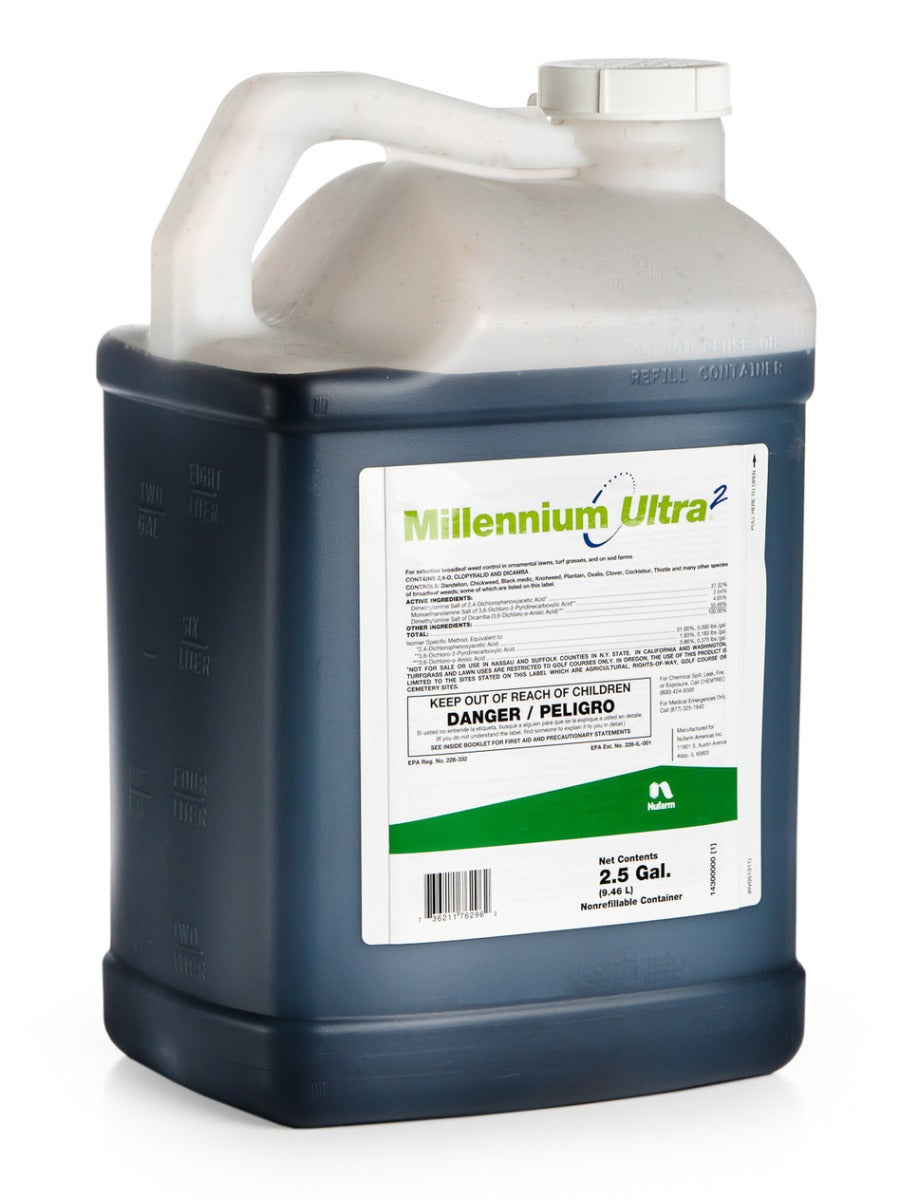

Description
- Description
- Specs
- Labels and SDS Forms
Millennium Ultra 2 Selective Herbicide
Millennium Ultra 2 Herbicide is a premium professional postemergence broadleaf herbicide combining 2,4-D, clopyralid, and dicamba for powerful weed control in non-residential turf and vegetation-management sites. Its systemic HRAC Group 4 synthetic-auxin chemistry is absorbed and translocated through susceptible plants, delivering strong activity on difficult weeds including clover, speedwell, chickweed, plantain, thistle, goldenrod, nettle, Virginia buttonweed, and many other annual and perennial broadleaf species.
Specifically formulated for commercial turf, Millennium Ultra 2 is labeled for athletic and recreational fields, cemeteries, sod farms, golf courses, industrial sites, non-cropland, rights-of-way, and roadsides. The three-active formulation provides rapid visible response, excellent clover control, and systemic performance on deep-rooted perennial weeds while remaining compatible with many liquid fertilizer and iron programs when compatibility is confirmed before mixing.
Features & Benefits
✓ Combines 2,4-D, clopyralid, and dicamba in one professional three-way broadleaf herbicide
✓ Systemic HRAC Group 4 activity translocates through susceptible weeds for whole-plant control
✓ Excellent control of difficult weeds including thistle, speedwell, plantain, clover, henbit, and chickweed
✓ Strong activity on deep-rooted perennial weeds including goldenrod, artichoke, and nettle
✓ Rapid weed response and premium performance throughout the growing season
✓ Labeled for cool-season turf, bentgrass, and selected warm-season turfgrasses
✓ Compatible with many liquid fertilizer and iron formulations when a compatibility test is performed first
Labeled Use Sites
Millennium Ultra 2 is labeled for non-residential ornamental turf lawns, industrial and institutional turf, athletic and recreational fields including parks, playgrounds and sports fields, cemeteries, sod farms, golf courses, industrial sites, non-cropland, rights-of-way, and roadsides. Golf-course use includes fairways, aprons, tees, roughs, and naturalized areas, but bentgrass tees and golf course greens are excluded. Labeled turfgrasses include bluegrass, fescue species, ryegrass, bentgrass where permitted, bahiagrass, common bermudagrass, and zoysiagrass. Do not use on residential turfgrass, centipedegrass, St. Augustinegrass, or dichondra.
Target Weeds
Millennium Ultra 2 controls the complete label-listed spectrum of alder, artichoke, aster, wild aster, bedstraw, pineywoods bedstraw, beggartick, Florida betony, Biden, bindweed, field bindweed, hedge bindweed, bitter wintercress, hairy bittercress, bitterweed, black-eyed Susan, bloodflower milkweed, boxelder, brassbuttons, bristly oxtongue, broomweed, buckhorn, wild buckwheat, bur ragweed, burdock, burweed, buttercup, bulbous buttercup, carpetweed, wild carrot, catchweed bedstraw, catnip, catsear, spotted catsear, corn chamomile, chickweed, common chickweed, mouseear chickweed, chicory, cinquefoil, rough cinquefoil, western clematis, clover, annual yellow sweet clover, crimson clover, hop clover, red clover, strawberry clover, sweet clover, white clover, cockle, cocklebur, spiny cocklebur, coffeebean, coffeeweed, plains coreopsis, creeping jenny, croton, woolly croton, cudweed, curly indigo, English daisy, oxeye daisy, dandelion, fall dandelion, false dandelion, dock, dogbane, dogfennel, elderberry, fiddleneck, Austrian fieldcress, redstem filaree, false flax, fleabane, hairy fleabane, rough fleabane, flixweed, Florida pusley, wild four-o’clock, Frenchweed, galinsoga, smallflower galinsoga, wild garlic, Carolina geranium, wild geranium, goathead, goatsbeard, goldenrod, ground ivy, groundsel, gumweed, hawkweed, orange hawkweed, healall, heartleaf drymary, heathaster, poison hemlock, hemp, henbit, hoary cress, honeysuckle, horsenettle, horsetail, ironweed, poison ivy, jewelweed, jimsonweed, spotted knapweed, knawel, knotweed, prostrate knotweed, kochia, lambsquarter, lespedeza, blue lettuce, prickly lettuce, wild lettuce, locoweed, lupine, mallow, Indiana mallow, Venice mallow, roundleafed marigold, wild marigold, marshelder, matchweed, black medic, Mexicanweed, morningglory, woolly morningglory, mugwort, common mullein, mustard, black mustard, garlic mustard, hedge mustard, tansy mustard, tumble mustard, white mustard, wild mustard, nettle, bull nettle, burning nettle, dead nettle, stinging nettle, tall nettle, poison oak, wild onion, oxalis, field pansy, parsley-piert, parsnip, wild parsnip, pearlwort, pennycress, pennywort, peppergrass, pepperweed, Virginia pepperweed, pigweed, prostrate pigweed, redroot pigweed, Russian pigweed, smooth pigweed, tumble pigweed, scarlet pimpernel, plantain, black-seed plantain, bracted plantain, broadleaf plantain, buckhorn plantain, hoary plantain, narrowleaf plantain, slender plantain, woolly plantain, pokeweed, poorjoe, povertyweed, prickly sida, primrose, puncturevine, purslane, wild radish, ragweed, wild rape, southern wild rose, rush, western salsify, shepherdspurse, smartweed, sneezeweed, red sorrel, sheep sorrel, sowthistle, common sowthistle, Spanishneedle, spatterdock, speedwell, spiny amaranth, spurge, prostrate spurge, spotted spurge, spurweed, St. Johnswort, stinkweed, stitchwort, wild strawberry, sumac, sunflower, false sunflower, wild sweet potato, tansy ragwort, tanweed, tarweed, thistle, blessed thistle, bull thistle, Canada thistle, musk thistle, Russian thistle, Scotch thistle, toadflax, trailing crownvetch, tick trefoil, tumbleweed, velvetleaf, veronica, vervain, blue vervain, hoary vervain, prostrate vervain, tall vervain, vetch, bird vetch, milk vetch, narrowleaf vetch, wild vetch, Virginia buttonweed, Virginia creeper, wavyleaf bullthistle, willow, witchweed, woodsorrel, wormseed, yarrow, yellow rocket, and yellowflower pepperweed.
Application Notes
For cool-season turf including bluegrass, fescue species, and ryegrass, apply 2 to 3 pints per acre. Bentgrass applications, excluding golf course greens and tees, use 1.5 to 2 pints per acre. For labeled warm-season turf including bahiagrass, common bermudagrass, and zoysiagrass, apply 2 to 3 pints per acre. Use lower rates when turf is under drought stress or other unfavorable growing conditions.
Millennium Ultra 2 is limited to two postemergence applications per year. Do not exceed 4 pints per acre in a single application or 8 pints per acre per season, excluding spot treatments. Sod-farm applications require at least 21 days between treatments. Do not collect treated grass clippings for mulch or compost, and do not send treated clippings to a compost facility. Reseed no sooner than 3 to 4 weeks after application.
Product Information
Active Ingredients: 2,4-D Dimethylamine Salt 37.32% (equivalent to 2,4-D acid 31.00%, 3.0 lb/gal) + Clopyralid Monoethanolamine Salt 2.54% (equivalent to clopyralid acid 1.93%, 0.183 lb/gal) + Dicamba Dimethylamine Salt 4.65% (equivalent to dicamba acid 3.86%, 0.375 lb/gal)
Mode of Action: Systemic synthetic auxin growth regulators that disrupt normal growth and development in susceptible broadleaf weeds
HRAC Group: 4
Chemical Families: Phenoxycarboxylic Acid + Pyridine + Benzoic Acid
Formulation: Liquid
EPA Reg. No.: 228-332
Manufacturer: Nufarm Americas Inc.
Signal Word: DANGER
Brand: Millennium Ultra 2
Recommended Surfactant: ProSurf 90
| ACTIVE INGREDIENT | 2,4-D 37.32% Clopyralid 2.54% Dicamba 4.65% |
| UPC | 1.91662E+11 |
| MANUFACTURER | Nufarm |
| EPA REGISTRATION | 228-332 |
| NOT FOR SALE TO | AK, AR, CO, CT, IN, KS, MA, NV, PR, WA, NY, VT (restricted To Licensed Applicators Only) |
Payment & Security
Your payment information is processed securely. We do not store credit card details nor have access to your credit card information.


