

Description
- Description
- Specs
- Labels and SDS Forms
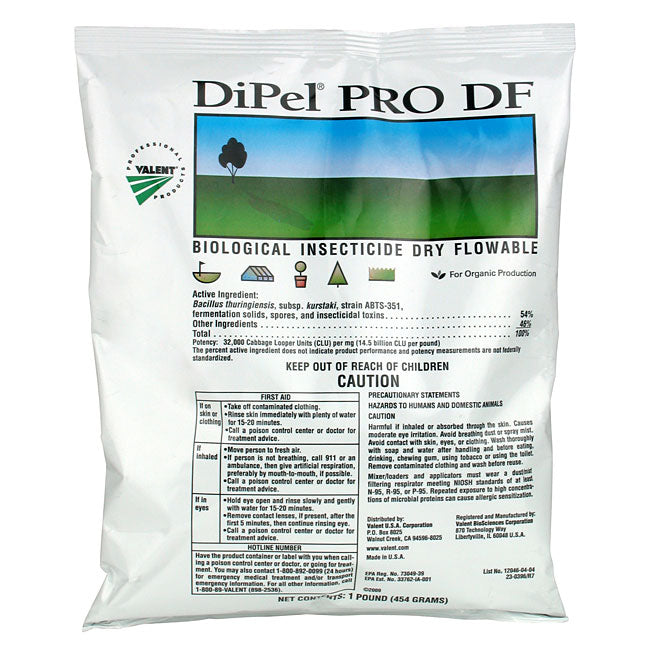
DiPel PRO DF Biological Insecticide
DiPel PRO DF is a professional biological insecticide containing Bacillus thuringiensis subsp. kurstaki strain ABTS-351 for control of destructive caterpillar larvae on turf, ornamentals, trees, greenhouse and nursery crops, agricultural crops, and other labeled plants. Once susceptible larvae consume treated foliage, feeding stops rapidly and the insects die within several hours to a few days.
As an IRAC Group 11A microbial insecticide, DiPel PRO DF provides a distinct mode of action that fits well into integrated pest-management and resistance-management programs. Its dry-flowable formulation is easy to measure and mix, carries a 4-hour REI and zero-day harvest interval, and is currently OMRI Listed® for use in organic production subject to applicable organic-program requirements.
Features & Benefits
✓ Biological insecticide powered by Bacillus thuringiensis subsp. kurstaki strain ABTS-351
✓ Controls a broad spectrum of labeled caterpillar and worm pests on turf, ornamentals, trees, greenhouse, nursery, and agricultural crops
✓ Larvae stop feeding within about one hour after ingesting a lethal dose
✓ IRAC Group 11A microbial mode of action provides a valuable resistance-management tool
✓ Four-hour REI and zero-day pre-harvest interval support flexible professional production programs
✓ Dry-flowable formulation mixes readily for ground, aerial, and labeled chemigation applications
✓ Currently OMRI Listed® for use in certified organic production where permitted
Labeled Use Sites
DiPel PRO DF is labeled across a broad range of agricultural and horticultural sites including turf, flowers, bedding plants, ornamentals, greenhouse and shadehouse crops, outdoor nurseries, forest trees, shade trees, ornamental trees, herbs, spices, vegetables, hemp, mint, peppermint, and many other labeled field crops. The label also includes selected aquatic ornamental plants such as water lilies, water hyacinths, and bog plants when grown in self-contained closed-system ponds.
Target Pests
DiPel PRO DF controls labeled caterpillar larvae including Achemon sphinx moth, alfalfa caterpillar, almond moth, amorbia moth, armyworms, artichoke plume moth, azalea caterpillar, bagworm, banana moth, banana skipper, blackheaded budworm, box tree moth, California oakworm, cankerworms, cherry fruitworm, China mark moth, citrus cutworm, codling moth, corn earworm, cotton bollworm, tomato fruitworm, cranberry fruitworm, cross-striped cabbageworm, cutworms, diamondback moth, Douglas fir tussock moth, ello moth, elm spanworm, European corn borer, European grapevine moth, European skipper, fall webworm, filbert leafroller, fruit-tree leafroller, fruit-tree tortrix, grape berry moth, grape leafroller, grapeleaf skeletonizer, green cloverworm, greenstriped mapleworm, gum moth, gypsy moth, headworm, head moth, hemlock looper, hornworms, imported cabbageworm, Indian meal moth, Io moth, Jack pine budworm, light brown apple moth, loopers, melonworm, mimosa webworm, obliquebanded leafroller, oleander moth, omnivorous leafroller, omnivorous looper, orangedog, orange tortrix, Oriental fruit moth, peach twig borer, pine butterfly, podworm, redbanded leafroller, raisin moth, redhumped caterpillar, rindworm complex, saddleback caterpillar, saltmarsh caterpillar, sod webworm, southern cornstalk borer, soybean looper, spanworm, spring and fall cankerworms, spruce budworm, sugarcane borer, tent caterpillars, tobacco budworm, tobacco hornworm, tobacco moth, tufted apple budmoth, twig borer, variegated cutworm, variegated leafroller, velvetbean caterpillar, walnut caterpillar, webworms, and western tussock moth.
Application Notes
DiPel PRO DF must be eaten by actively feeding caterpillar larvae to work. Apply when larvae are young and before significant plant damage occurs. Thorough coverage of exposed plant surfaces is essential. Under heavy pest pressure, use the higher labeled rate, shorten application intervals, and increase spray volume where appropriate. Repeat applications generally every 3 to 14 days depending on plant growth, moth activity, rainfall, and pest pressure.
Rates vary by crop and pest. Turf, flowers, bedding plants, ornamentals, greenhouse, and nursery programs commonly use 0.5 to 2 lb per acre. For smaller-volume spray programs, the label provides proportional rates down to approximately 1/2 teaspoon per gallon at the 1/4 lb-per-acre or 100-gallon rate. A compatible spreader-sticker may be used on hard-to-wet crops or where improved weatherfastness is needed. Do not mix more spray solution than can be used within the label-specified period.
Product Information
Active Ingredient: Bacillus thuringiensis subsp. kurstaki strain ABTS-351 54%
Mode of Action: Microbial stomach-active insecticide; susceptible larvae must ingest treated plant material, after which feeding stops rapidly and mortality follows
IRAC Group: 11A
Chemical Family: Microbial / Bacillus thuringiensis
Formulation: Dry Flowable (DF)
EPA Reg. No.: 73049-39
Manufacturer: Valent BioSciences LLC; distributed by Valent U.S.A. LLC
Signal Word: CAUTION
Brand: DiPel PRO DF
Recommended Surfactant: ProSurf 90 may be used where a compatible spreader or wetting agent is appropriate; the label specifically recommends a compatible spreader-sticker for hard-to-wet crops or improved weatherfastness.
| ACTIVE INGREDIENT | Bacillus thuringiensis Subsp. Kurstaki, Strain ABTS-351 54% |
| MANUFACTURER | Nufarm |
| EPA REGISTRATION | 73049-39 |
| NOT FOR SALE TO | AK, PR |
Payment & Security
Your payment information is processed securely. We do not store credit card details nor have access to your credit card information.


