

Description
- Description
- Specs
- Labels and SDS Forms
2-D Selective Broadleaf Herbicide
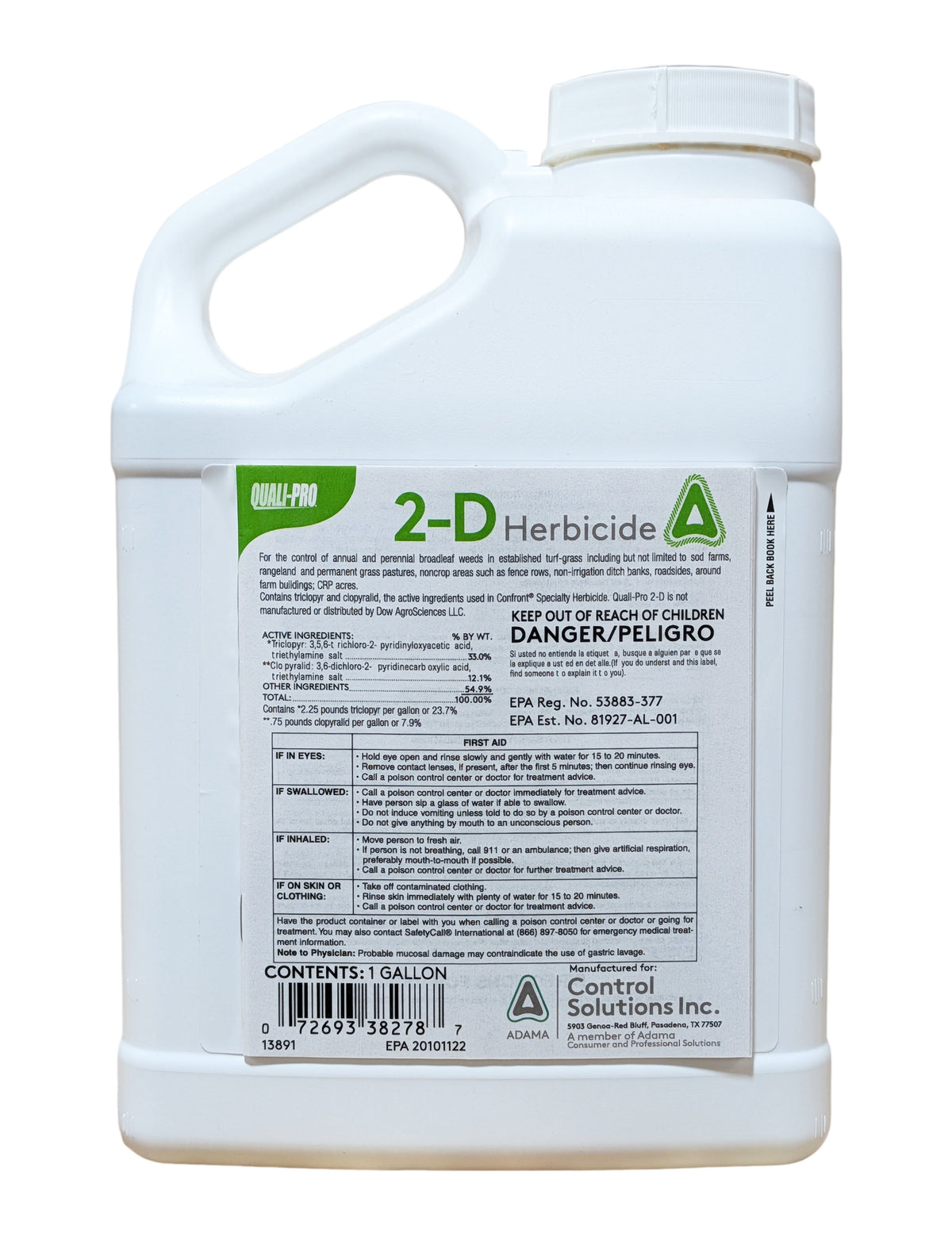
2-D Herbicide is a professional systemic postemergence herbicide combining triclopyr and clopyralid for powerful control of annual and perennial broadleaf weeds in established non-residential turf, sod farms, rangeland, permanent grass pastures, and labeled non-crop areas. Its dual synthetic-auxin chemistry moves through susceptible weeds for deep, whole-plant control of difficult species including clover, dandelion, plantain, oxalis, thistle, goldenrod, wild violet, and many other broadleaf weeds.
Formulated with the same active ingredients and concentrations found in Confront® Specialty Herbicide, 2-D provides a professional generic alternative for commercial weed-management programs. Quali-Pro supports 8 to 12 weeks of reliable weed control from a single application, while the low-odor liquid formulation is well suited for golf, commercial, public, range, pasture, roadside, and other labeled professional applications.
Features & Benefits
✓ Dual-active formulation combines 33% triclopyr and 12.1% clopyralid for systemic broadleaf weed control
✓ Generic alternative to Confront® Specialty Herbicide with matching active ingredients and concentrations
✓ Systemic activity moves through susceptible plants for deep, to-the-root control
✓ Manufacturer-supported control lasting approximately 8 to 12 weeks from a single application
✓ Broad-spectrum activity on difficult annual and perennial weeds including clover, thistle, plantain, oxalis, and wild violet
✓ Labeled across numerous established cool- and warm-season turfgrasses plus rangeland, pasture, CRP, and non-crop areas
✓ Low-odor liquid formulation is well suited for professional commercial and public weed-management programs
Labeled Use Sites
2-D is labeled for established non-residential cool- and warm-season turfgrass, golf course fairways, sod farms with specific turf restrictions, rangeland, permanent grass pastures, Conservation Reserve Program acres, fence rows, non-irrigation ditch banks, roadsides, areas around farm buildings, and other labeled non-crop areas. Do not use on residential turf, golf course putting greens, or tees. Bermudagrass on sod farms must not be treated.
Labeled cool-season turfgrasses include bentgrass, Kentucky bluegrass, chewing fescue, creeping red fescue, sheep fescue, and perennial ryegrass. Labeled warm-season turfgrasses include bahiagrass, bermudagrass, buffalograss, centipedegrass, tall fescue growing in warm-season areas, and zoysiagrass. Warm-season turf maintained below 1/2 inch should not be treated.
Target Weeds
Turf Broadleaf Weeds: black medic, hop clover, red clover, white clover, American burnweed, common chickweed, common cocklebur, common vetch, creeping beggarweed, dwarf beggarweed, false dandelion, hawkweed, henbit, matchweed, mouse-ear chickweed, roundleaf mallow, sheep sorrel, spotted catsear, spurweed, broadleaf plantain, burdock, coffeeweed, common dandelion, common ragweed, lambsquarters, narrowleaf plantain or buckhorn plantain, shepherdspurse, Virginia pepperweed, Canada thistle, common yellow woodsorrel, creeping woodsorrel, curly dock, English lawn daisy, goldenrod, lespedeza, musk thistle, poison ivy, smartweed, wild buckwheat, and wild violet.
Rangeland, Pasture & Non-Crop Targets: bull thistle, distaff thistle, milk thistle, musk thistle, plumeless thistle, annual broomweed, burdock, red clover, white clover, common cocklebur, coffeeweed, cornflower or bachelor button, croton, common dandelion, false dandelion or spotted catsear, goldenrod, common groundsel, henbit, horseweed, jimsonweed, black knapweed, diffuse knapweed, meadow knapweed, spotted knapweed, lambsquarters, prickly lettuce, locoweed, marshelder, nightshade, Virginia pepperweed, pineappleweed, broadleaf plantain, narrowleaf or buckhorn plantain, common ragweed, western ragweed, meadow salsify, shepherdspurse, bitter sneezeweed, smartweed, red sorrel, sheep sorrel, annual sowthistle, yellow starthistle, common sunflower, common teasel, vetch, absinth wormwood, hairy buttercup, curly dock, horsenettle, oxeye daisy, chicory, western ironweed, tansy ragwort, rush skeleton, perennial sowthistle, wavyleaf thistle, tropical soda apple, hawkweed, Russian knapweed, mallow, and Canada thistle. Spiny amaranth or pigweed and dogfennel are labeled for suppression at specified rates.
High-Volume Foliar Woody Targets: blackberry, kudzu, locusts, Macartney rose, and multiflora rose are included under the label's specific high-volume foliar treatment directions.
Application Notes
For non-residential turf, apply 1 to 2 pints of 2-D per acre. Standard broadcast applications use 20 to 200 gallons of finished spray per acre, while labeled low-volume applications may use 5 to 20 gallons per acre. Spot treatments may be made with 0.5 fl oz of product in enough water to make 1 gallon of spray, applied over approximately 1,000 sq ft. Repeat turf applications should be spaced at least four weeks apart.
Apply when broadleaf weeds are actively growing. Only weeds that have emerged at the time of application will be controlled. Do not irrigate turf for six hours following treatment. For rangeland, permanent pasture, and non-crop uses, a nonionic surfactant is required and rates generally range from 1.5 to 2 pints per acre for annual weeds and up to 4 pints per acre for specified deep-rooted perennial weeds. Follow all site-specific grazing, haying, clipping, composting, crop-rotation, and state restrictions on the label.
Product Information
Active Ingredients: Triclopyr Triethylamine Salt 33.0% + Clopyralid Triethylamine Salt 12.1%
Acid Equivalents: Triclopyr 23.7% (2.25 lb ae/gal) + Clopyralid 7.9% (0.75 lb ae/gal)
Mode of Action: Systemic synthetic auxin herbicides that mimic natural plant hormones and cause uncontrolled growth in susceptible broadleaf weeds
HRAC Group: 4
Chemical Family: Pyridine Carboxylic Acid / Synthetic Auxin
Formulation: Liquid
EPA Reg. No.: 53883-377
Manufacturer: Control Solutions, Inc. / Quali-Pro
Signal Word: DANGER
Brand: 2-D
Generic For: Confront Specialty Herbicide
Recommended Surfactant: For standard turf broadcast applications, no routine surfactant is required. ProSurf 90 or another nonionic surfactant may be used for labeled low-volume turf applications. A nonionic surfactant is required for rangeland, permanent pasture, and non-crop applications.
| ACTIVE INGREDIENT | Triclopyr 33%, Clopyralid 12.1% |
| MANUFACTURER | Quali Pro |
| EPA REGISTRATION | 53883-377 |
| NOT FOR SALE TO | AK, NY, VT |
| COMPARABLE PRODUCTS | Confront |
Payment & Security
Your payment information is processed securely. We do not store credit card details nor have access to your credit card information.


